Dives 52-62 took place in Maui
from April 21st to April 26th 2007.
Lahaina
Divers
hosted the Handicapped Scuba
Association’s first trip to Maui; which I am very glad to have
been a part of. I was impressed with the expensive handicapped
renovations done to the hotel we stayed at (the Royal Lahaina) and
to the boats we were diving off. Using the facilities in the hotel
was expected, even though some of the accommodations there had only
been completed the day before the first wheelchair users arrived.
The large dive boats were modified so that we wheelchair users could
use the spacious heads (lavatories) thereby speaking volumes about
the concern and generosity of Lahaina Divers.
In the short three years I’ve
been diving, I don’t think I’ve ever met one boat captain that was
less than stellar. The Lahaina Divers boat Captain is named Dan and
he is no exception. His skill in both boat handling and crew
management is awesome. His communication skills are great; which
compliments his thorough and inexhaustible knowledge of the dive
sites he has been showing divers for close to thirty years. Perhaps
the most astounding quality of Captain Dan is that on several
occasions he donned mask and (possibly?) flippers to come down to
where we were diving. His free style diving closely resembles that
of the dolphins he no doubt has communed with. This man truly swims
like a dolphin when he comes down to say hello to those of us divers
who, by comparison, are confined by our bulky equipment.
The boat crew also was smart when
it came to assisting all the handicapped divers in our group. No
matter what the ability level of our group, from the very paralyzed
to the moderately paralyzed, the boat crew exercised respectful
assistance and tasteful hospitality. We each were made to know we
were all completely welcome in every aspect of our diving
requirements. From getting us onboard to pulling us each out of the
water, this crew is the best I’ve seen to date. Their techniques are
truly a model for an industry standard in both safety and
convenience.
The diving—Maui in late April is
perfect. We may have arrived about ten days too late to spot the
whales we hoped for but we could still hear them calling each other
in the distance. The weather was what I’ve come to expect in Hawaii,
perfect. The water temp was also consistent with my other Hawaiian
dives, meaning that the winter temperature was still a comfortable
76 degrees or better for all dive sites. For our group, the Captain
was kind enough to show us dive sites that were not only of great
interest from a divers perspective but also dive sites that were
suitable for handicapped divers. By this I mean that the sites we
went to had very little current and were usually 79 degrees or
better. For me to experience nearly no current in Hawaii is truly a
pleasant surprise, perhaps there was some Divine Intervention in
play as well.
I went on this trip not so much
to have a vacation, though that was certainly achieved, but mainly
to work on some specific dive skills. In the months leading up to
the trip, I was looking through the HSA requirements for Advanced
Scuba Diver because I wanted to be prepared for the first dive trip
of the season. I wanted to work on skills that I was weak on. Skills
that I knew needed improvement. I knew I would have the privilege of
being with Jim Gatacre and that was important to me. From diving
under his tutelage last June in Bon Aire, I had already discovered
how knowledgeable he is in all things related to handicapped scuba.
It is my firm belief that no one on planet Earth knows more about
handicapped scuba than Jim and I wanted to learn as much as possible
from him on this trip. Starting with fish identification I studied
my previous dive log entries to familiarize myself with what types
of creatures to expect. The HSA requirements state that I needed to
know the ecological niche that various creatures occupied. I needed
not only to identify them but also to know what behavior to expect
from them. This homework really made my dives more enjoyable because
I was able to identify more fish than if I had just shown up and
didn’t know what to expect.
I also wanted to work on my dive
planning. Perhaps this is where my greatest lessons of the entire
trip were learned. I really was able to take an introspective look
at my behavior and see what I was doing. I made several mistakes
that were significant. Up to this point in my diving life, I had
nearly always been with a guide. On those few occasions where I was
buddied up with another novice, it was with an able bodied novice
who, because of me being paralyzed, always cut me whatever slack I
took. The result was that I usually didn’t effectively communicate
with my dive buddy in a way that true dive buddies are taught to.
Before Maui, I usually just did what ever I wanted and they
accommodated that. Nor did I previously have a tremendous need to
plan my dives; I either followed the guide or he followed me. Other
than a brief description of the dive site, I never really gave much
thought to how to be a good dive buddy on any particular dive. I
never bothered learning how to take care of a buddy in an emergency,
how to dump his weights and how to tell each other that one of us
needed to share air. This trip taught me
better.
Here I need to draw your
attention to the May 2007 edition of Dive Training magazine. There is an article
by Marty Snyderman entitled THE LOST BOY: A story of Panic and
Personal Accountability. As described on page 67, there are
risks associated with not planning dives. There are risks to not
communicating with your dive mates prior to diving off the boat.
There are risks to me expecting others to know what I want as if
they should be clairvoyant. These are risks that many divers simply
will not take with 60 feet of water above their heads; nor should
they be expected to take risks simply because I failed to plan. It
is my responsibility to clearly communicate my intentions for the
dive before I jump in. Since using a dive buddy is required on
nearly all the dives I make, it is my responsibility to make sure we
are both on the same page and that we are each capable of performing
tasks associated with whatever the dive may encompass. If I have no
intention of trying to follow my buddy to wherever he decides to go,
I need to verbalize that before we jump in, that is part of
planning. Most importantly, if I decide I’m going back to the boat
or even just back to where the boat is anchored, I need to make that
buddy aware of my decision. If I fail to let that person know, he
will start looking for me. If I accidentally shoot up to the
surface, I need to make that buddy aware of what happened to me as
best that I possibly
can.
Yes, I made some mistakes on this week
at Maui. Yes I am very lucky that I had someone like Jim Gatacre
with me to show me exactly what my mistakes were, why they are
important to correct and to teach me more about how to plan my dives
properly. Did that take away from the enjoyment of the dive? No,
certainly not. Learning how to be a better diver, especially
learning from someone like Jim, is a real privilege.
More learning? You bet. This time from
one of the great boat crew. A young man named Jonathon helped me
with some buoyancy issues I knew I needed to work on. When I told
him I thought I wasn’t over-weighted with 7mm of neoprene and 19
pounds of lead, he said that he has seen plenty of divers that had
lost a weight pouch on the bottom and not even known it until they
were back in the boat. Those words brought me back to another young
man in Aruba who was my dive guide. He told me flat out that I only
needed 8 pounds of lead in a 3mm suit. In both cases I was skeptical
but remembered the advice. In both cases I now know they were right
to help me with their advice. The bottom-line here isn’t just that I
was over-weighted but that I was using my weights the wrong way. I
was thinking only of how I didn’t want to be upside down because I
can’t clear my mask in that position (yet). I thought I needed those
ankle weights, at least on my knees, until after getting down past
15 feet, at which point I sometimes remembered to move them to my
shoulder straps and thus, kept my feet from dragging. What I
discovered in Maui was that I do not need the ankle weights at all
past 15 feet. In fact I
dove much better without them entirely. At depth, without the ankle
weights, not only did I maintain the proper horizontal dive profile
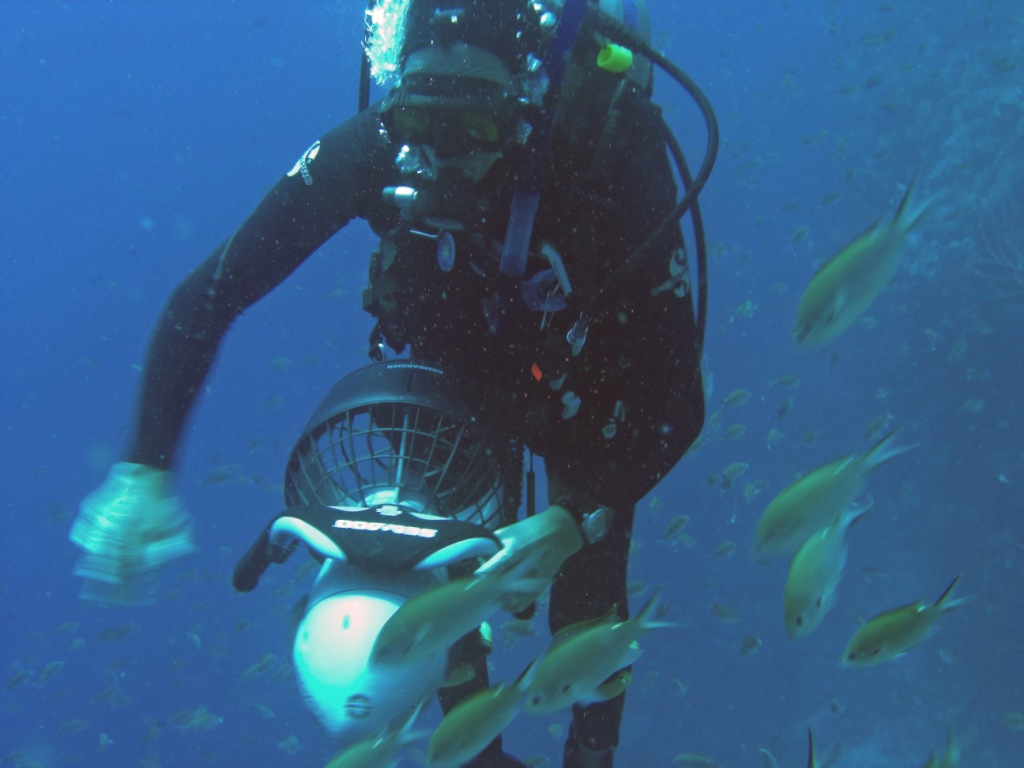
(which is very important when using a scooter- as I usually do) but
I was also still only slightly negatively buoyant (instead of
grossly over-weighted.) I also learned that, yes, without the ankle
weights I may have to struggle a little to stay upright the first
10-15 feet, but that’s ok, that’s what the descent line is for. When
I use the descent line to get past the first 10 –15 feet, I can
still sink like a rock without being
over-weighted.
Even more learning? Yup, from
all the boat crew and from other divers as well. Too many examples
to continue listing but suffice it to say it was a really terrific
trip for lots of reasons. The dive sites? They are AWESOME. You
really should go see them all for yourself. Captain Dan and his crew
will take very good care of you. Mahalo!
-Pete
.